
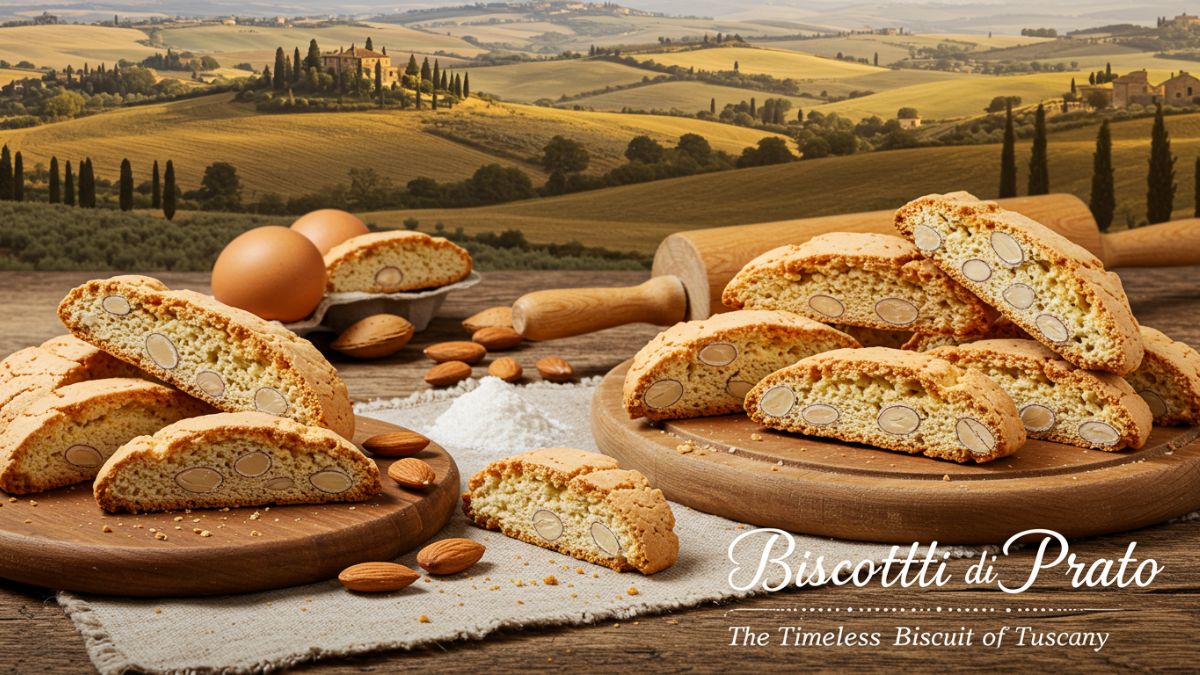
Бишкоти ди Прато, the iconic twice-baked almond biscuit, has been enchanting the streets of Prato for over a century, carrying with it the aromas, stories, and traditions of Tuscany. Even before dawn light spills over the narrow cobbled lanes of Prato, you can almost smell it — a faint, warm scent of toasted almonds, sugar, and oven‑warmed dough, drifting from the timeworn doors of the historic bakery on Via Ricasoli. That aroma carries centuries of tradition: brittle, golden, twice‑baked cookies with a heritage so rich it anchors a region’s identity. This is the world of Biscotti di Prato — known in some tongues as “Бишкоти ди Прато.” It is more than a biscuit; it is a ritual, a link between past and present, solitude and community, simple ingredients and complex history.
Origins & Early History: From Rome to Tuscany’s Hearth
The roots of Biscotti date deep — to the days of the Roman Empire, when hardy, dry breads and biscuits were baked to last long sea voyages or overland journeys. The very word biscotti derives from the Medieval Latin biscoctus, meaning “twice‑cooked,” a practical technique to remove moisture and prolong shelf life. Wikipedia+2Wikipedia+2
But while twice-baked breads and biscuits existed in many forms across Europe, it was in the heart of Tuscany — in Prato — where the biscuit evolved from mere travel ration to culinary icon. References to a local biscuit appear in an 18th‑century Prato manuscript; yet the defining moment came in the 19th century, when a baker named Antonio Mattei opened his eponymous biscotti factory in 1858. cittadiprato.it+2Visit Tuscany+2
Mattei’s genius lay not only in business acumen, but in his refined, austere recipe: flour, sugar, eggs, whole almonds (and sometimes pine nuts), with no butter, no yeast, no oils — and a dedication to the double‑bake that gave the biscuits their signature crunch. Visit Tuscany+2cittadiprato.it+2
By 1867, the world took notice: Mattei exhibited his biscuits at the Universal Exhibition in Paris, earning acclaim and helping cement “Biscotti di Prato” as not just a regional treat, but a global standard. Visit Tuscany+2sloweurope.com+2
Over time, while variations of twice‑baked biscuits emerged elsewhere in Italy and beyond, the original Prato method remained largely unchanged — a testament to tradition and a commitment to authenticity. cittadiprato.it+2manicaretti.com+2
Modern Significance: The Bittersweet Dance of Crunch and Ritual
Today, Biscotti di Prato occupy a unique place: both a humble pantry staple and a refined symbol of Tuscan culinary heritage. In cafés across Italy — and increasingly in artisan bakeries abroad — they are served not only as cookies, but as vessels of memory and ritual.
Traditionalists dip them in a small glass of sweet straw wine, typically Vin Santo, letting the hard biscuit soften and release its almond‑scented richness. manicaretti.com+1 Modern palates, however, have embraced versatility: biscotti crumble over ice cream, pair with morning espresso, or sit alongside gelato as a crunchy counterpoint. BizzBuzz+2manicaretti.com+2
For many, Biscotti di Prato represent more than a snack — they are a slice of Tuscany itself: rustic, unpretentious, rooted in simplicity, and yet timelessly elegant. A way to taste history, one bite at a time.
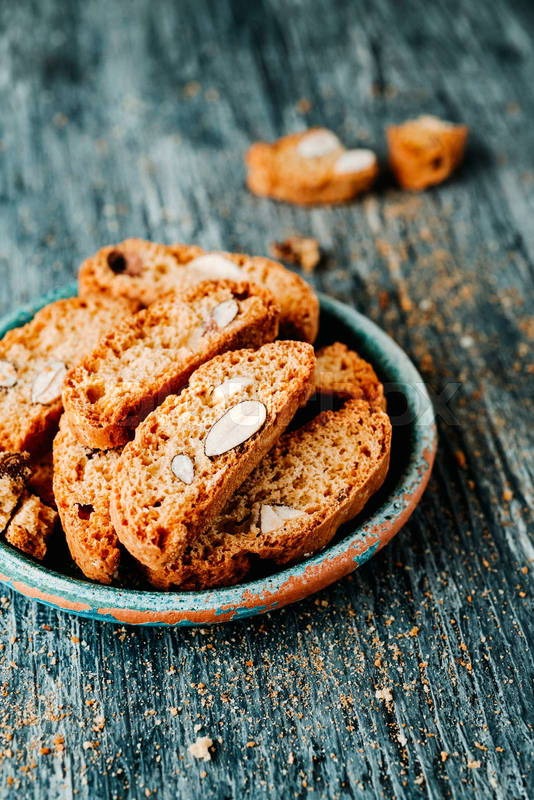
Geographic Heart: Where It Flourishes — The City of Prato & Tuscany
Nestled between Florence and the Apennines, the city of Prato is no ornate tourist hub, but rather a working‑class cradle of textile mills, cobbled alleys, and resilient artisans. It is here, amid narrow medieval lanes and sun-bleached stone façades, that Biscotti di Prato was born — and continues to thrive.
The original bakery, still located on Via Ricasoli, remains a pilgrimage site for food lovers. Visitors may walk in quietly, inhale the warm scent of almonds and sugar, and trace the slow arc of tradition from dough mixing to slicing loaves, then baking, then packaging — a ritual unchanged for more than a century and a half. Visit Tuscany+1
The broader landscape — rolling Tuscan hills, vineyards, olive groves — lends itself to slow living. Biscotti di Prato is often enjoyed where time slows: at sunset on a balcony overlooking cypress-lined hills, or over a late‑lunch in a trattoria after a stroll through an olive orchard. The taste of almonds, the dryness of biscuit, and the softness of dipping wine evoke the rhythm of Tuscan life: deliberate, sensory, rooted.
Styles & Variations: From the Classic to the Contemporary
While the essence of Biscotti di Prato remains unchanged, over time bakers have introduced variations — some faithful, some experimental.
- Traditional Cantucci / Cantuccini: The pure recipe: flour, sugar, eggs, whole almonds (skin on), occasionally pine nuts; no fat, no leavening. Twice‑baked, hard, crunchy — meant for dipping. Wikipedia+2Simply Great Recipes+2
- Nuts & Additions Variants: Some artisanal bakers play with pistachios, hazelnuts, or add pine nuts for subtle variation. But purists argue that anything beyond almonds & pine nuts distills the spirit of Prato. manicaretti.com+2Yooooga+2
- Modern Sweet Twists: Chocolate‑dipped biscotti, biscotti with dried fruit, or versions adapted for coffee and afternoon tea rather than dessert wine. BizzBuzz+2manicaretti.com+2
- Textural Variation: Some bakers introduce a slightly softer biscuit — less dry, more crumbly — to suit modern tastes, though this crosses a line for traditionalists. Simply Great Recipes+2wvia.org+2
Yet through every variation, the identity of Biscotti di Prato remains anchored by its defining traits: almond‑forward flavour, twice‑baked crunch, and above all, ritual — dipping, sharing, savoring.
Cultural & Environmental Impact: More Than Just a Biscuit
Biscotti di Prato is not merely a cookie; it is emblematic of regional pride, artisanal tradition, and culinary identity. For the inhabitants of Prato, these biscuits are part of local heritage — a tradition passed from generation to generation, a small but poignant emblem of continuity.
The production too — artisanal, small‑scale, hands‑on — stands in contrast to industrialized mass production. The historic bakery founded by Antonio Mattei in 1858 still operates, preserving the recipe and craft almost unchanged. sloweurope.com+2cittadiprato.it+2
In a broader sense, Biscotti di Prato serves as a symbol of sustainable culinary values: simplicity, locality (local eggs, regional almonds or pine nuts), no unnecessary ingredients, and slow food philosophy. In a world moving fast, each brittle almond bite encourages mindfulness.
How to Experience It — Practical Tips & Traditions
If you ever find yourself in Tuscany, here’s how to savor Biscotti di Prato properly:
- Where to go: Visit the historic original bakery on Via Ricasoli in Prato. Wander the narrow streets, inhale that warm, sweet, nutty scent. Watch the loaves being baked, cooled, sliced, and double-baked — imagine how little has changed since the 1800s.
- When to try: Late morning, with coffee or espresso; after dinner, dipped in a small glass of Vin Santo; or in the afternoon with tea or hot chocolate.
- How to serve: Do not treat them like soft cookies. To fully appreciate them: dip briefly into liquid — traditionally Vin Santo, but milk, coffee, or even hot chocolate works. The dunking softens the biscuit, releasing almond aroma and enhancing sweetness.
- Storage: Thanks to the twice-baked method and absence of fat, they store well. A crisp biscuit today remains crisp in weeks.
- For home bakers: Use simple ingredients (flour, sugar, eggs, whole almonds — optionally pine nuts), shape the dough into a log, first bake; slice when warm; then bake again until thoroughly dry and golden. No butter, no yeast, no milk.
Biscotti di Prato in Global Context: How It Compares
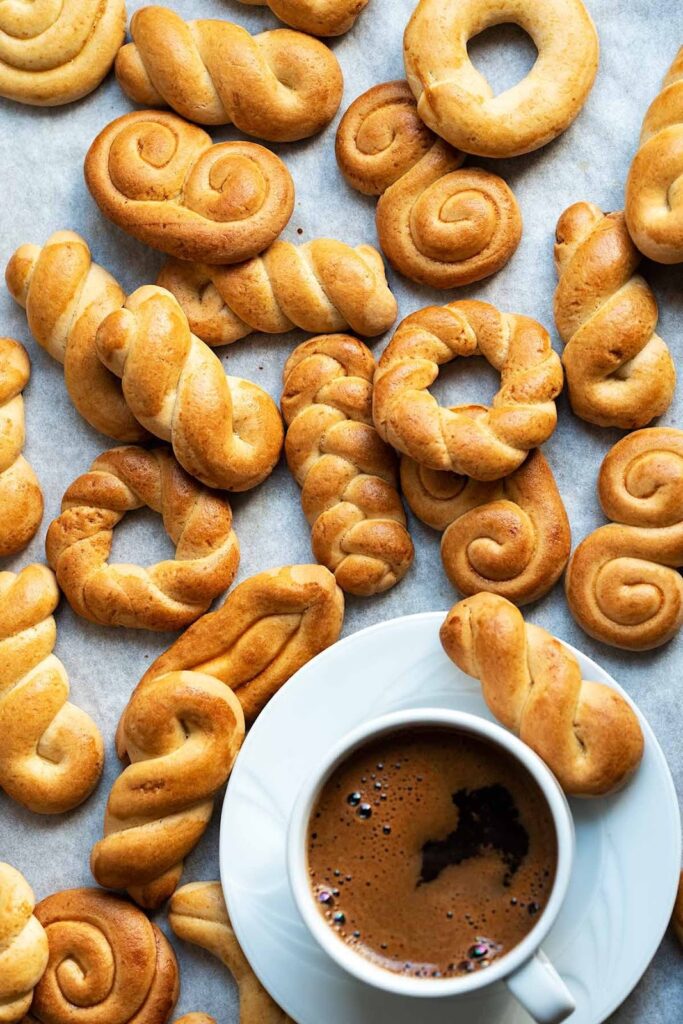
| Tradition / Biscuit | Mood & Setting | Common Ingredients / Tools | Cultural Focus | Main Appeal |
| Biscotti di Prato (Italy, Tuscany) | Rustic Tuscany — café tables, vineyards, evening dessert | Flour, sugar, eggs, whole almonds (sometimes pine nuts); twice‑baked loaves sliced warm | Regional identity, artisanal craft, slow‑food heritage | Crunchy biscuit → dunk → almond aroma + light sweetness |
| Zwieback (Germany / Central Europe) | Practical, travel‑ready, long shelf‑life (sailors, journeys) | Flour, water, salt or sugar; baked twice | Preservation for journeys, simplicity | Durable bread/biscuit, very long shelf life wvia.org+1 |
| Carquinyoli / Rosegons (Catalonia / Valencia, Spain) | Rural Mediterranean, inland villages, afternoon breaks | Almonds or nuts, sugar, sometimes shaped differently | Local tradition, communal baking, Mediterranean almond culture Wikipedia+1 | Similar crunch, nutty flavour, often more rustic |
| Modern Espresso/ Coffee Biscotti (Global cafés) | Urban cafés, breakfast, quick dunk in espresso or cappuccino | Flour, sugar, eggs, often added fats, flavorings, nuts or chocolate | Fusion, convenience, café culture | Balanced sweetness, softer crunch, coffee‑friendly bite |
Table 2 explores how Biscotti di Prato fits in a broader global tradition of twice‑baked biscuits, highlighting both shared traits and unique cultural signatures.
Expert Insight: Voices from Prato
Setting: A grey, misty mid‑morning in early autumn; inside the small, timeworn bakery on Via Ricasoli. The air is warm, redolent with almond fragrance. Outside, cobblestones glisten from overnight rain. I sit across from Lucia — a fourth‑generation baker whose family has worked here since the days of Antonio Mattei. Sunlight filters through a dusty window; the soft crack of slicing loaves punctuates our conversation.
Q: Lucia, when did you first realise these biscuits were more than just food — that they were heritage?
A: “I remember as a little girl — I’d come in after school and see my nonna gently guiding her hands over dough. She’d say: ‘Here we do not just bake biscuits, we bake memory.’ I think I understood it first when a tourist came and closed her eyes, inhaled the almond scent, and said: ‘This smells like Tuscany I always dreamt of.’ That’s when I felt it was more than a recipe.”
Q: Many versions and flavors now exist — chocolate, pistachio, dried fruit. Does that worry you, with respect to tradition?
A: “Tradition isn’t a cage — it’s a compass. I believe the classic must stay: flour, sugar, eggs, almonds, maybe pine nuts, twice baked. Anything else is an echo, a variation. For tourists, for dessert tables abroad — fine. But when I make biscotti here, I make it for Tuscany, for those who hear the crunch and taste the land.”
FAQs — Common Questions About Biscotti di Prato
Q: What is the difference between ‘Biscotti di Prato’ and ‘cantucci’ or ‘cantuccini’?
A: They refer to the same tradition. ‘Cantucci’ (or diminutive ‘cantuccini’) is another regional name for the twice‑baked almond biscuits from Prato. The processes and ingredients remain the same. Wikipedia+2cittadiprato.it+2
Q: Does traditional Biscotti di Prato contain butter or oil?
A: No — the traditional recipe uses only flour, sugar, eggs, whole almonds (and sometimes pine nuts). No butter, oil, milk, or leavening agents are used. Wikipedia+1
Q: Why are they twice baked?
A: The first bake cooks the dough; the second bake, after slicing when warm, dries them thoroughly. This double-bake yields a very dry, hard, long‑lasting biscuit — ideal for storage, travel, and dipping. Wikipedia+2Visit Tuscany+2
Q: What is the traditional way to eat them?
A: The classic way is to dip the biscuit in a small glass of sweet Tuscan wine (Vin Santo). The dunk softens it and releases its almond aroma and gentle sweetness. Modern alternatives include espresso, tea, hot chocolate, or as accompaniment to gelato or ice cream. manicaretti.com+2Yooooga+2
Q: Can I store them — how long do they last?
A: Yes. Thanks to the twice‑baked technique and absence of fats, Biscotti di Prato keep well for weeks if stored in a dry, sealed container.
What Can We Learn — Takeaways from a Tiny Biscuit
- Simplicity endures: In a culinary world chasing novelty, Biscotti di Prato reminds us that elegance often lies in restraint — just five basic ingredients, time, and care.
- Food as memory: A biscuit becomes more than nourishment when it carries history, geography, and identity in every crunch.
- Tradition adapts: While variations proliferate, the core remains recognizable — a delicate balance between preserving heritage and embracing modern tastes.
- Slow culture wins: In a rush‑driven world, a biscuit that invites dipping, waiting, savoring, and perhaps reflection offers a small but vital resistance.
Conclusion: The Future of Biscotti di Prato — Crunching Through Time
In our frenetic age, where flavours come and go, and “authenticity” too often becomes marketing talk, the quiet persistence of Biscotti di Prato stands out. In the small bakery on Via Ricasoli, ovens still glow, dough is still rolled by hand, and almonds are still shelled and folded with care.
Maybe one day the world will only know them as “almond biscotti” in generic cafés. But for those who care — for those who smell that almond warmth, taste the brittle crunch, soak it in a glass of wine or sip espresso — Biscotti di Prato will remain what they always were: a whisper of Tuscany in a busy world.
A biscuit, yes — but also a story baked twice.